Imagine being able to put your marketing campaigns on autopilot effortlessly and having all those time-consuming routine tasks handled automatically, leaving you free to focus entirely on the creative aspects of your business. That is exactly what marketing automation enables you to do.
This technology acts like an invisible employee, working around the clock and always finding the most efficient ways to get your message to the right person at the right time. Marketing automation is far more than just a passing trend—it is a strategic necessity for every modern business.
Let’s discover together how you can harness this transformative power to reach your marketing goals effortlessly while strengthening customer relationships.
Automation
WhatsApp messages often achieve impressive open rates of up to 90% and receive faster responses than traditional emails. The casual, conversational nature of WhatsApp Newsletter makes it perfect for lively exchanges with customers.
This high interaction rate is supported by push notifications that appear directly on users' lock screens, capturing immediate attention without having to bypass spam filters.
An innovative feature is the use of keyword campaigns to reach new customer groups. Companies share keywords via channels such as social media or QR codes. Customers who use these keywords are automatically guided through an interaction path, enabling seamless and automated communication.
Furthermore, multimedia content such as videos, images, and links can be integrated into campaigns to further increase customer attention and offer them a rich, interactive experience. This type of interaction fosters a more personal relationship with customers and improves brand loyalty.
With the help of bots, companies can automatically send product recommendations or reminders about discount promotions, saving valuable time and increasing efficiency. Automation ensures that companies can focus on strategic tasks while routine processes run reliably in the background.
Overall, using WhatsApp as a marketing automation platform offers not only warm and personal customer engagement but also an efficient way to increase sales and optimize your marketing strategy.
Practical Use Cases for Automation in WhatsApp
WhatsApp automation is used across various industries for customer support, appointment reminders, and promotional messaging. For example, healthcare providers can send automated follow-up messages to patients to improve adherence to treatment plans. Retailers use the platform to send personalized offers and product recommendations, which increases customer loyalty. In the tourism industry, automated messages can be used to send booking confirmations and travel tips, thereby improving customer service.
Introduction to the ChatFlow Builder
The ChatFlow Builder from ChatWerk offers a user-friendly no-code solution for creating automated WhatsApp campaigns. With features like dynamic parameters and seamless automation, it effortlessly improves customer interaction. The ChatFlow Builder makes it possible to create complex communication strategies without the need for programming skills. This allows companies to design interactive and personalized customer journeys that increase engagement and satisfaction. By integrating with other marketing channels, including the evaluation of marketing ROI, companies can develop a coherent and comprehensive marketing strategy that covers all aspects of customer interaction.

Comparing Email and WhatsApp Automation
Pros and cons of each method
Email automation is well-established and offers comprehensive analytics, but it lacks the immediacy of WhatsApp. WhatsApp is more engaging but may require careful management of message frequency. Both methods have their strengths and weaknesses, and the choice depends on a company's specific requirements and goals. A marketing automation system can assist here by optimizing the planning, management, and analysis of marketing activities while enabling personalized communication.
Emails are better suited for detailed content and long-term communication, while WhatsApp is ideal for quick updates and conversational exchanges. Companies should consider their target audience's preferences and choose the platform that best aligns with their communication goals.
Integration options
Combining both platforms can leverage their respective strengths, such as initiating customer conversations on WhatsApp and following up with detailed emails. By integrating email and WhatsApp automation, companies can develop a comprehensive communication strategy that covers all aspects of customer interaction.
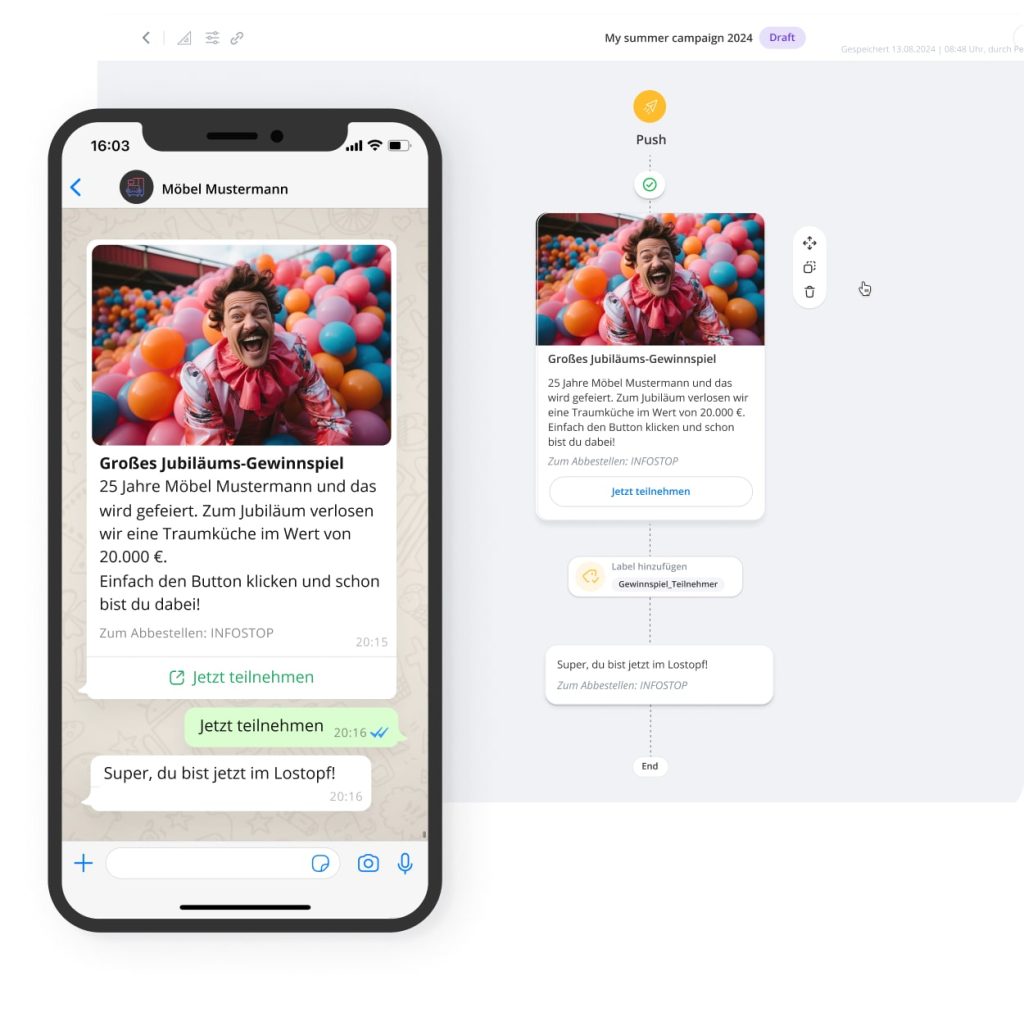
How the ChatFlow Builder can bridge the gap
TheChatFlow-Builder integrates WhatsApp with other marketing channels, creating a cohesive strategy that improves reach and engagement. By utilizing the strengths of both platforms, companies can ensure they effectively reach and engage their target audience.
WhatsApp automation examples with ChatFlow
Redefining retail customer service
A retail brand used the ChatFlow Builder to automatecustomer service on WhatsApp , reducing response times and increasing satisfaction. Through automation, they were able to provide 24/7 service without increasing the team's workload.
Healthcare meets technology
In the healthcare sector, the ChatFlow Builder supports patient communication and improves adherence to treatment plans through automated reminders. This type of automation can help increase patient satisfaction while simultaneously improving the efficiency of healthcare providers.
Retailers focus on personalized experiences
Retailers use the ChatFlow Builder for personalized shopping experiences by sending targeted offers and product recommendations via WhatsApp. This type of personalized communication can increase customer loyalty and boost sales.
The future of marketing automation
Emerging trends
The future lies in the integration of AI and machine learning, which enable more predictive and personalized interactions. These technologies will allow companies to better understand customer behavior and adapt their strategies accordingly. Marketing automation tools are essential for success in online marketing, as they not only optimize marketing workflows but can also be adapted to different industries and company sizes.
The role of AI and machine learning
AI enables companies to anticipate customer needs and further improve the effectiveness of automation tools. By using AI, companies can offer personalized experiences on a whole new level while simultaneously increasing the efficiency of their marketing efforts.
Final thoughts
As digital transformation continues, tools like the ChatFlow-Builder will be at the heart of simplifying marketing efforts and maintaining competitiveness. Companies that invest in these technologies will be able to optimize their marketing strategies and provide better service to their customers.

Discover the ChatFlow-Builder
What if you could increase your conversion rates by up to 90% while simultaneously reducing the costs of traditional retargeting?
With its no-code functionality, you can easily create everything from dynamic chatbots and marketing campaigns in one place, utilizing powerful dynamic parameters to automate responses and personalize interactions—all without a developer.
TheChatFlow-Builder is more than just a tool; it is a game-changer for companies looking to improve their digital interactions and customer experiences via WhatsApp and beyond. Don't miss the opportunity to transform your marketing approach—book a demo today.
Lerne noch mehr über Kundenkommunikation
Weitere spannende Blogartikel rund um Marketing, Automatisierung und digitalen Kundenservice.